Data & AI services for banks — advise, build, transform, run.
DaasLabs teams set your data and AI strategy, build the platforms, transform finance, risk and operations, and run what we build. Our Data Fabric Framework, pre-built accelerators and a supervised digital workforce of AI agents are how we deliver it faster.
Live now: – supervised agents on duty in the demo control room
Bank data, finance and AI programmes stall because every one starts from zero.
Siloed systems, manual finance processes and long implementations mean value arrives late — or not at all.
Typical industry figures, not client results.
1 · No governed data foundation
Core banking, card switches, payment gateways and ERPs don't agree — lineage and quality are unknown.
2 · Services firms rebuild from scratch
Each project re-invents pipelines, models and controls, so timelines and fees grow.
3 · Software alone doesn't change the process
Point products solve one use case and leave integration, data and adoption to the bank.
4 · AI pilots never reach production
Proofs of concept built without data, controls and an operating model stay on the shelf.
Banks are moving from copilots to supervised digital workforces.
Agents now work cases end to end in reconciliation, onboarding and financial crime; people supervise the exceptions.
So what for a bank: the operating model moves from “AI assists a person” to “agents do the work, a person supervises many agents” — which makes governance, autonomy limits and audit trails the deciding capabilities.
Figures reported by banks, vendors and analysts — not DaasLabs results.
A services firm that arrives with its own IP — so banks pay for outcomes, not reinvention.
Services
Nine service lines across advise, build, transform and run — delivered by teams who know banking products, ledgers and regulation.
Data Fabric Framework
The governed foundation: the 4C method, 167+ pre-built connectors, metadata, lineage, data quality and security.
Accelerators
Six flagship and nine solution accelerators — pre-built, configurable starting points for each service line.
Supervised digital workforce
AI agents that do the routine work end to end, with people approving exceptions and every step logged.
Nine service lines cover the lifecycle, organised the way banks buy them.
Select a stage on the wheel, or start from your role.
Set direction and the rules the data must meet.
Data & AI StrategyMaturity assessment, AI operating model, business case Data Governance & Regulatory DataCDO set-up, BCBS 239, lineage, DQ, AI governanceEngineer the platforms and the AI that runs on them.
Data Engineering & Platform ModernisationPipelines, lakehouse, cloud platforms AI & Agentic EngineeringGenAI, document AI, supervised agent squadsChange how a business function works, end to end.
Finance TransformationClose, recon, accounting hub, intercompany, FP&A, SOX Risk, Compliance & Financial CrimeAML, fraud, disputes & chargebacks Customer & GrowthCustomer 360, cross-sell, next-best-action Operations & AutomationRPA, control tower, revenue assuranceKeep it healthy and improving after go-live.
Managed ServicesDataOps, MLOps & AgentOps under SLAsEvery service line runs on the same framework, accelerators and digital workforce. All services in detail →
A repeatable 4C method turns raw bank data into production-ready capabilities in 30–45 days.
- Step 1 · Week 1–2Connect167+ pre-built connectors to core banking, cards & payment rails, GL/ERP, CRM, risk and documents; batch and streaming.
- Step 2 · Week 2–4CurateStandardise, cleanse and enrich: MDM, de-duplication and data quality rules.
- Step 3 · Week 3–5ContextualizeMetadata catalog, critical data elements, multi-hop lineage, ownership and policy.
- Step 4 · Week 4–6ConsumeData products, APIs, BI, NLQ GenAI studio and the agents behind each accelerator.
Twelve capability layers give every bank one blueprint — and one way to measure progress.
The same layers we build and score in the maturity assessment. Hover a layer to see what it does.
Runs in your cloud tenancy or on-prem. Code, ontology and agents are handed over — you own what we build. Explore the blueprint →
MIT CISR found enterprises at stages 3–4 perform well above their industry average financially, while those at stages 1–2 perform below it. Source
Fifteen accelerators mean no service line starts from a blank page.
Pre-built, configurable starting points on the framework — many staffed by an agent squad. Hover or tap a tile.
Finance Transformation CFO
Risk, Compliance & Fin. Crime CRO
Data Governance CDO
Customer & Growth Business
Six flagship accelerators turn the hardest finance and growth problems into weeks-long deployments.
CLARION and NARRATOR: delivered results from our banking engagements. LEDGER360, NEXUS and CATALYST: design targets for each accelerator, not measured client results.
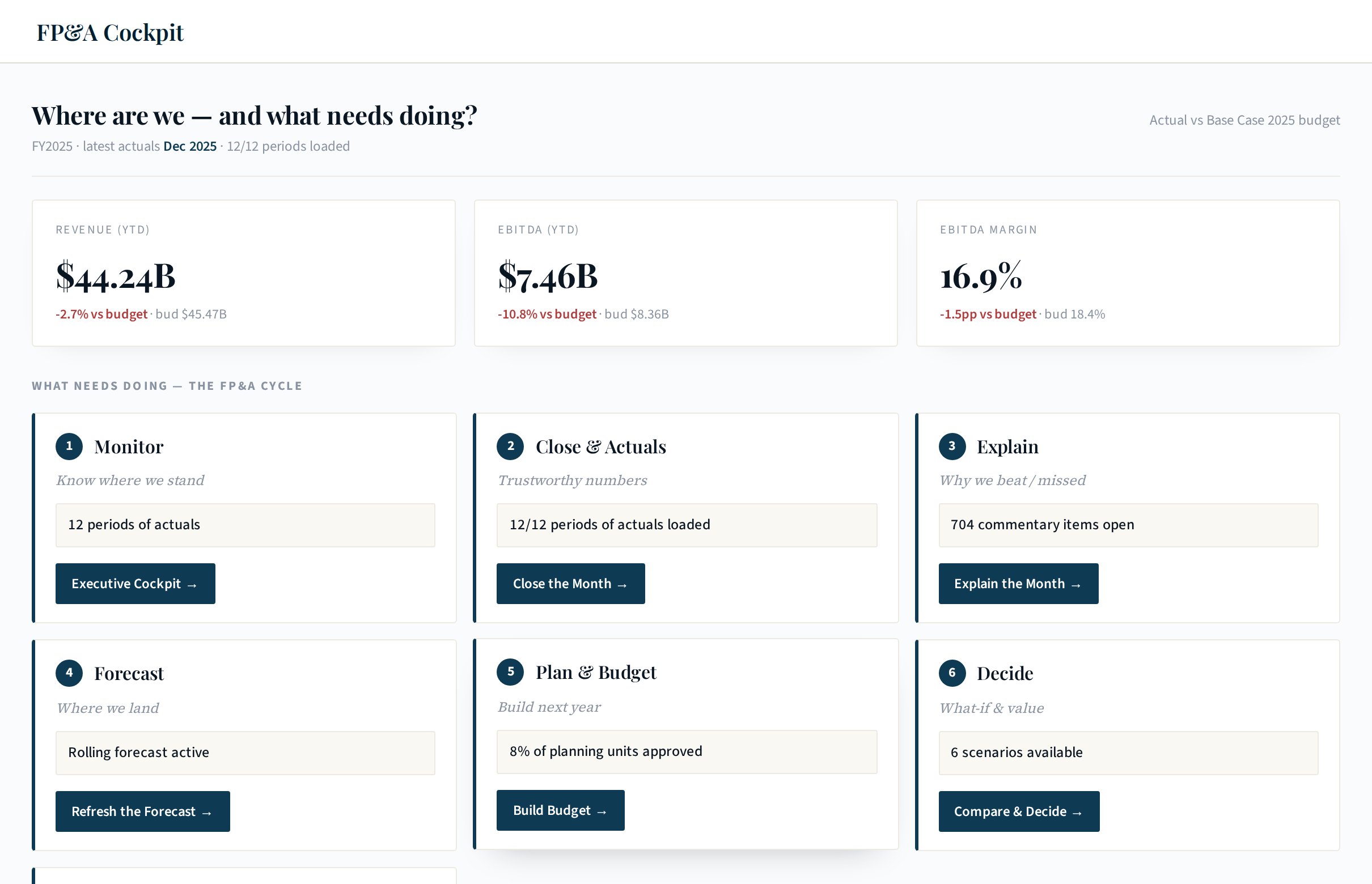
COMPASS · FP&A & performance. Ledger to landing in one workspace: 7 steps on one spine, 57 FP&A modules and 5 supervised agents — AI drafts, people sign off. See the screens →
A supervised digital workforce, by line of business — your people supervise the exceptions.
Agents work end to end across wealth, investment banking, correspondent banking, cards & payments, retail, corporate banking and trade finance. Policy decides what goes straight through; people approve the exceptions.
Click a bar to see the agents in it.
Agents plan, call tools and gather evidence. Policy decides what goes straight through; a named owner approves everything else; a kill switch halts all agents.
Live figures come from the DaasLabs demo environment — not client results.
An agent does the legwork on every case; a person makes the call when policy says so.
Replay: a settlement on the payments rail doesn't match the ledger. The Break Investigator (CLARION) works it.
- 1Source systemsThe payment rail reports a settlement the core ledger hasn't booked the same way — amount and value date differ.
- 2Data fabricChange-data capture lands both records within minutes, quality-checked, as governed data products.
- 3Metadata & ontologyBoth resolve to the same counterparty, nostro account and product, with lineage back to each source.
- 4ContextMatching rules, similar past breaks and the recon procedure are assembled — only what this analyst may see.
- 5AgentPlans and calls tools through the secure AI gateway:
get_exceptionfind_candidate_matchesget_system_pair_stats; proposes a match with evidence and a confidence score. - 6PolicyKill switch, autonomy level, confidence ≥ 0.90 and amount ≤ PHP 5,000 decide: straight through, or to a person.
- 7Human gateThe operations analyst reviews the evidence on one screen and approves, edits or rejects the proposal.
- 8ActionA governed, typed action resolves the break in the reconciliation system — limited, idempotent and reversible.
- 9AuditEvery step, tool call and decision is recorded; outcomes feed the evaluation that decides whether autonomy can be raised.
Autonomy is set per agent and raised only on evidence — inside hard guardrails.
Confidence threshold
Straight-through only if confidence, amount limit and evidence checks pass.
Amount limits
Recon breaks and disputes above the limit always go to a person.
Named human owner
Approves, edits or rejects every exception; AML dispositions always need a person.
Everything logged
Every plan, tool call and decision; overrides feed evaluation. Personal data masked in prompts.
Kill switch
One control halts every agent at once.
Global banks have already realised these gains with DaasLabs teams.
Selected banking engagements. Client names are withheld; outcomes are from delivered work.
Auto-commentary for book close (NARRATOR)
Per Balance Sheet & P&L report: 80% less time and 90% fewer errors, integrated with Oracle GL / SAP.
AI/ML auto-match for open items (CLARION)
80–90% of open items auto-matched — exact, tolerance, aggregate and one-to-many — and a 50% reduction in reconciliation FTE.
Data strategy & CDO function
Metadata repository, critical data elements, lineage for regulatory reports, DQ controls and operating model.
Accounting hub design & build
Source-to-target mapping, data models, governance and metadata for automated entries to DWH and ERP.
Intercompany data flow
Architecture and standardised data flow for the intercompany process, replacing fragmented hand-offs.
What could a supervised agent squad free up in your operation?
Move the sliders to your own volumes. Agents work the cases; people review only the exceptions.
Estimate only, not a quote or a DaasLabs result. Manual hours = cases × minutes ÷ 60. Supervised hours = cases × (1 − STP share) × review minutes ÷ 60. Hours saved = manual − supervised. FTE = hours saved ÷ 150. Cost saved = hours saved × cost per hour. Supervisor capacity = 150 h × 60 ÷ ((1 − STP share) × review minutes). Excludes platform and run costs.
Faster than services alone, a better fit than software alone.
How the DaasLabs model compares with the usual ways banks deliver data, AI and agentic automation.
| Criterion | Big-4 / SIservices only | Point productssoftware only | In-house build | DaasLabsservices + framework + accelerators |
|---|---|---|---|---|
| Time to production value | 6–12 months | 3–6 months + integration | 12–18 months | 30–45 days |
| Banking data models & domain depth | Generic methods | One use case | Build | Pre-built |
| Reusable data foundation | Rebuilt per project | Vendor-specific | Build | Data Fabric Framework |
| Ready-made accelerators | Varies | Single product | None | 15 for banking |
| Supervised AI agents in operations | Pilots / PoCs | Copilot features | Build & govern | Agent squads with guardrails & AgentOps |
| Process change & adoption | Yes | Left to bank | Partial | Yes |
| Run & continuous improvement | Separate contract | Product support | Internal team | Managed services |
| Total cost of ownership | High | Medium–High | Very High | Low |
Big-4 / SI (6–12 months), point products (3–6 months + integration) and in-house builds (12–18 months) are compared on larger screens.
Four phases, each ending with something you keep — and three ways to buy it.
Discovery & Planning
You receive a maturity assessment and target blueprint, with a prioritised roadmap.
Gate: pilot scope signed offAnalysis & Design
Target-state design and ontology, mapped to your controls; agent autonomy agreed with risk.
Gate: design authorityBuild & Deploy
Landing zone as code, pipelines, accelerators and agents configured and tested on real data.
Gate: go-live readinessSupport & Embed
Runbooks, evaluation suites and knowledge transfer to a trained team.
Gate: handover sign-offStaff Augmentation
Architects, data and AI engineers embedded in your teams, under your delivery lead.
Project Delivery
Outcome-based delivery of an accelerator or platform build by a DaasLabs pod, with phase gates.
Managed Services
We run and improve the platform, models and agents — DataOps, MLOps and AgentOps under SLAs.
A 30–45 day accelerator pilot proves value on one use case before you commit to scale.
Fixed scope, fixed timeline, agreed success criteria — and a scale-up business case at the end.
One accelerator & its agent squad
Typically CLARION (reconciliation) or NARRATOR (close commentary), agents starting at “act with approval”.
2–3 source systems
e.g. GL, core banking and a payment or card switch.
One business unit
Named business owner and SMEs for rules and UAT.
DaasLabs pod
Engagement lead, data engineer, domain SME, AI / agent engineer.
Success-criteria targets are agreed in week 1.
Three steps take us from this conversation to value in production.
Start small with one accelerator, prove it, then scale on the same framework.
Scoping workshop
Walk through your data landscape and pain points, pick the pilot use case and agree success criteria.
1–2 weeksAccelerator pilot
Deploy one accelerator and its agent squad on the framework against live data, and measure the result.
30–45 daysScale & embed
Roll out across business units and further accelerators through project delivery or managed services.
Project or managed serviceinfo@daaslabs.ai · Talk to us · Back to the site · © 2026 DaasLabs